
If you’re getting married in South Africa, your marriage will automatically fall under the “community of property” system unless you take legal steps to opt out. This means your assets and debts will be combined with your spouse’s. To avoid this, you can choose between an antenuptial contract (ANC), signed before marriage, or a postnuptial contract signed after marriage. Here’s the key difference:
- Antenuptial Contracts: Signed before marriage, this option is simpler and cheaper (R1,450–R1,900). It lets you choose how to manage your assets – either keeping them separate or sharing only the growth during your marriage. It also protects you and your spouse from each other’s creditors.
- Postnuptial Contracts: Signed after marriage, this option is more complex and expensive (R15,000–R20,000). It requires approval from the High Court and involves notifying creditors and publishing notices. It’s useful for couples who didn’t sign an ANC or whose financial situation has changed significantly.
Both contracts are essential tools for managing your financial independence, protecting assets, and simplifying estate planning. However, antenuptial contracts are easier and more affordable to set up, while postnuptial contracts involve legal hurdles and higher costs.
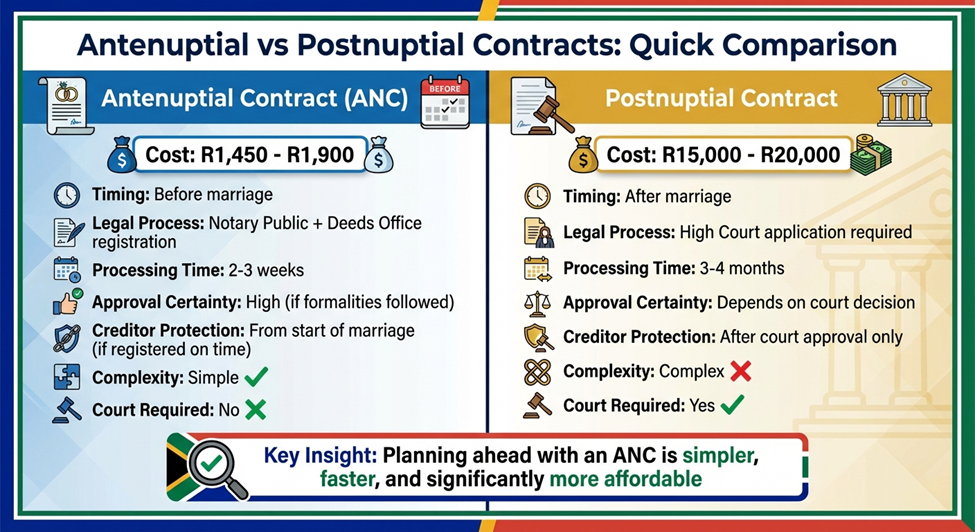
Quick Comparison:
| Factor | Antenuptial Contract (ANC) | Postnuptial Contract |
| Cost | R1,450–R1,900 | R15,000–R20,000 |
| Timing | Before marriage | After marriage |
| Legal Process | Notary + Deeds Office | High Court approval |
| Processing Time | 2–3 weeks | 3–4 months |
| Approval Certainty | High | It depends on court |
| Creditor Protection | From start of marriage | After court approval |
Planning ahead with an antenuptial contract is usually the better option. However, if you’re already married, a postnuptial contract can still help you adjust your marital property regime. Always consult a legal professional for personalised advice.
1. Antenuptial Contracts
Timing and Execution
An antenuptial contract must be finalised before your wedding day. Once you’re officially married, this option is no longer available. The contract needs to be prepared and executed by an admitted and practising Notary Public, with two competent witnesses present – both of whom must be at least 14 years old.
To ensure everything is in order, consult a Notary Public at least a month before your wedding. After signing, the contract should be registered promptly to make it legally enforceable.
Legal Process and Requirements
After signing, the antenuptial contract must be registered at the Deeds Office within three months. The registration process typically takes about two to three weeks. If the contract is signed outside South Africa, you’ll need to register it within six months.
If you miss the registration deadline, the contract will still be valid between you and your spouse, but it won’t hold any legal weight against third parties, like creditors. One original copy is kept by the Notary Public, while another is lodged with the Registrar of Deeds.
Impact on Assets and Estates
An antenuptial contract determines whether your marriage will follow the ‘with accrual’ or ‘without accrual’ system. Here’s how these work:
- With accrual: Each spouse maintains their own estate during the marriage, but any growth in their estates is shared equally when the marriage ends – whether through divorce or death.
- Without accrual: Each spouse’s assets remain entirely separate throughout the marriage, with no sharing of growth.
Additionally, antenuptial contracts protect spouses from each other’s creditors. They also allow both parties to act independently in financial matters, meaning either spouse can enter into major transactions without needing the other’s permission.
Suitability for Estate Planning
Antenuptial contracts offer a clear structure that can simplify estate planning. They help safeguard inheritances, business interests, and assets acquired before the marriage. Specific assets, like a family business or certain properties, can be excluded from accrual calculations, ensuring they stay within the family.
Including a ‘commencement value’ – essentially, your net worth at the time of marriage – can also be helpful. This value is subtracted from the final estate when calculating shared growth. Without an antenuptial contract, a joint estate may face a lengthy winding-up process if one spouse passes away. However, with an antenuptial agreement, the surviving spouse retains full access to their separate estate, avoiding unnecessary delays.
2. Postnuptial Contracts
Timing and Execution
A postnuptial contract is signed after marriage to adjust your matrimonial property regime. This is typically done if no antenuptial contract was signed before the marriage or if there have been major changes in your circumstances since then.
Unlike antenuptial contracts, postnuptial contracts involve a more complex process. You can’t simply visit a Notary Public to sign the agreement. Instead, you’ll need to make a formal application to the High Court under Section 21 of the Matrimonial Property Act 88 of 1984. Both spouses must agree to the change, and you’ll need to present valid reasons for it. This extra layer of legal scrutiny makes postnuptial contracts more involved than their antenuptial counterparts.
Legal Process and Requirements
To create a postnuptial contract, you must follow a formal procedure laid out in Section 21 of the Matrimonial Property Act. This includes publishing your intent in the Government Gazette and two local newspapers, notifying all known creditors by registered post, and informing the Registrar of Deeds at least seven days before your court hearing.
When applying to the High Court, you’ll need to submit a range of documents. These include your marriage certificate, a detailed list of your assets and liabilities, information about all creditors, and your income tax numbers. The court will only approve the application if it’s satisfied that no creditors, children, or other dependents will be negatively affected by the change.
Once the High Court grants the order, the contract must be signed before a Notary Public and registered at the Deeds Office within three months. The entire process usually takes three to four months and can cost between R15,000.00 and R20,000.00. This is significantly more expensive than the R1,450.00 to R1,900.00 associated with antenuptial contracts.
Impact on Assets and Estates
A postnuptial contract shifts the marriage from being ‘In Community of Property’ to ‘Out of Community of Property,’ with or without accrual. This change ensures that each spouse’s assets are kept separate. This is particularly useful if one spouse is involved in high-risk business ventures or is expecting a substantial inheritance.
Suitability for Estate Planning
Postnuptial contracts aren’t just about asset division – they’re also a key tool for estate planning. They’re especially helpful when financial circumstances change, such as starting a new business, receiving a large inheritance, or experiencing shifts in family responsibilities. By removing the complications of a community of property arrangement, these contracts make estate administration smoother. This ensures that individual estates remain accessible and manageable, even in the event of death.
Lawyer Explains the Different Types of Marital Contracts in South Africa
Advantages and Disadvantages
When it comes to estate planning under South African law, understanding the trade-offs between antenuptial and postnuptial contracts is essential. Both serve distinct purposes, and choosing the right one depends on timing, cost, and your marital regime preferences.
Antenuptial contracts are a simple and relatively affordable way to customise your marital property regime. These contracts must be signed before the wedding, requiring a notary and registration at the Deeds Office. However, if you don’t finalise an antenuptial contract before the ceremony, you’ll automatically be married in community of property – a default arrangement that may not suit everyone.
Postnuptial contracts, on the other hand, provide a solution for couples who didn’t sign an antenuptial contract before marriage or whose circumstances have changed significantly. These contracts allow you to move out of the default “in community of property” arrangement. The downside? They are more expensive and complex. Postnuptial agreements require a formal application to the High Court, and there’s no guarantee the court will approve the request. The process also involves stricter legal scrutiny and takes longer to finalise.
Here’s a quick comparison of the two options:
| Factor | Antenuptial Contract (ANC) | Postnuptial Contract |
| Cost | Lower legal fees, covering notary and registration | Significantly higher due to court application |
| Timing | Must be finalised before the wedding | Completed after the marriage |
| Legal Process | Involves a notary and Deeds Office registration | Requires a High Court application |
| Approval Certainty | High if legal formalities are followed | Dependent on court approval |
| Processing Time | Shorter | Longer due to court involvement |
| Creditor Protection | Effective from the start of the marriage (if registered on time) | Begins only after court approval |
These differences underscore the importance of planning ahead. Antenuptial contracts are generally more cost-effective and less complicated.
While skipping the upfront cost of an antenuptial contract might seem appealing, it can lead to long-term financial risks and challenges that far outweigh the initial savings.
Conclusion
Deciding between an antenuptial and a postnuptial contract boils down to timing, costs, and your personal situation. If you’re planning to marry, an antenuptial contract (costing between R1,450 and R1,900) can help you avoid the default “community of property” arrangement and safeguard your individual assets right from the start. On the other hand, if you’re already married without an antenuptial contract, a postnuptial agreement is an option. However, it comes with a higher price tag (R15,000–R20,000) and requires approval from the High Court.
Both contracts demand complete transparency regarding assets and debts. Failure to disclose this information can invalidate the agreement. A notable example is the 2014 case of B v B (Case No: 952/12), where unclear and inconsistent terms led the Supreme Court of Appeal to rule the marriage as “in community of property”. Accurate asset division is essential for effective estate planning, making precise legal drafting and proper registration non-negotiable. Seeking guidance from a qualified legal professional is crucial to ensure everything aligns with South African estate laws.

For personalised advice on marriage contracts and estate planning, reach out to Executor Law.
FAQs
What are the key advantages of signing an antenuptial contract instead of a postnuptial contract?
Opting for an antenuptial contract gives couples the chance to decide on their matrimonial property regime before tying the knot. Without this agreement, the marriage will automatically fall under the community of property system – unless specifically chosen otherwise. Taking this step early on ensures clarity, protecting assets like businesses or investments acquired before the marriage, and safeguarding each spouse from being held responsible for the other’s debts.
By signing and registering the contract ahead of the wedding, couples can steer clear of the expensive and lengthy process of applying to the High Court to change their property regime later. This agreement also allows for more control over how future assets and liabilities are handled, which is particularly useful for those with substantial individual assets or business interests.
What does the ‘with accrual’ system mean in an antenuptial contract, and how does it impact asset division?
The ‘with accrual’ system is a marital property regime where each spouse keeps ownership of the assets they had before getting married. However, any increase in the net value of their estates during the marriage is divided equally if the marriage ends, either through divorce or death.
When the marriage comes to an end, the process involves comparing the starting net value of each spouse’s estate (referred to as the commencement value) with its final net value. The difference between the two – called the accrual – is calculated. Certain exclusions are factored in, such as inheritances, legacies, and gifts, along with adjustments for inflation. If one spouse’s accrual is smaller, they receive a payment to ensure both parties equally share the growth in wealth accumulated during the marriage.
This system strikes a balance by safeguarding pre-marital assets while ensuring a fair division of the wealth gained during the union.
What is the process for setting up a postnuptial contract in South Africa?
To put a postnuptial contract in place in South Africa, couples need to follow a specific legal process to ensure the agreement holds up under the law. It starts with consulting a family law attorney to review your financial circumstances and discuss your objectives. Both spouses must provide complete financial disclosure, allowing the attorney to draft an agreement that reflects their unique situation.
Once the terms are finalised and both parties are satisfied, the contract must be signed in front of a notary public. After this, the agreement needs court approval to officially change the existing matrimonial property system. To make the contract fully effective, it must then be registered at the deeds registry within the required timeframe.
By following these steps, couples can ensure their postnuptial contract is legally binding and safeguarded under South African law.